

When someone starts looking for pottery classes in Barcelona, the same thing almost always happens: they open several websites, do a quick comparison, and end up with more questions than they had at the beginning. That’s normal. From the outside, many workshops seem similar. But they’re not.
If you’re starting from scratch, making the right choice matters a lot more than it seems. Not just because you want to learn, but because that first experience can either make you fall in love with clay or lead you to think—unfairly—that “this wasn’t for me.”
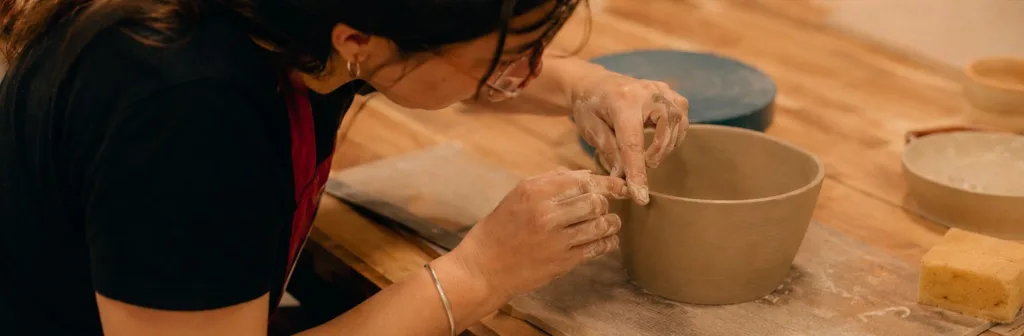
Not all workshops teach in the same way
There are spaces where the focus is more on doing a specific activity, and others where a process is truly built. There are places that are bigger, faster, and more impersonal. And others where the pace is more human, more attentive, and easier to get started without feeling like you’re being watched the whole time.
For me, one of the first things to consider is the size of the group. Pottery requires guidance. Not because it’s inaccessible, but because at the beginning, many small questions arise: how to handle the clay, how much pressure to apply, why one piece cracks, why another collapses. If there isn’t time to guide students through these questions, the experience changes.
What Good Pottery Classes Usually Include
When someone first starts out, they often imagine that pottery is just about shaping a piece—and that’s it. But a well-structured class usually includes much more: working with clay, tools, drying, firing, and, depending on the format, also the potter’s wheel, hand-building, engobes, glazes, and different ways to finish a piece.
It’s also important to check whether materials are included, whether firing costs are charged separately, and whether the workshop is designed for people who are truly starting from scratch. Sometimes an offering looks great on the surface, but it isn’t actually well-suited to helping someone get started.
If you’d like to see how we work, you can join one of our ceramics classes, where we’ll explain our approach, the class formats, and how we support the learning process in more detail.
Getting started shouldn’t be something to be ashamed of
This may sound silly, but it isn’t. You learn to work with clay using your hands, yes, but also with a certain inner calm. And if you find yourself in a place where you feel out of place, clumsy, or too slow, it’s much harder to let go.
On the other hand, when you have enough space, learning happens differently. You allow yourself to try. To fail. To try again. And little by little, something truly beautiful emerges: the moment when clay stops feeling strange and starts to feel familiar.
If you’re still not sure whether you’d prefer something on a regular basis or something more occasional, you can also check out our workshops, which are a great way to get started. And if you’d like to get a better sense of the space and understand everything we do, you can also visit the Tierra Cerámicas homepage.
How to Know Which Format Is Right for You
Not everyone approaches pottery the same way. Some people need a weekly class—almost like a little ritual. Others prefer to try it just once and then decide. And still others are drawn to clay out of curiosity, not yet sure whether they want to learn the technique or simply take a break.
That’s why, rather than asking yourself, “Which is the best workshop?” you might want to ask yourself something else: how would you like to get started? Sometimes the answer lies less in finding the perfect workshop and more in finding the pace that works for you.
Frequently Asked Questions About Choosing Ceramics Classes in Barcelona
What should I look for first when choosing a ceramics class?
The size of the group, the atmosphere, what the price actually includes, and whether the space is designed for people starting from scratch. That usually says a lot more than a pretty picture or a well-written description.
Is it better to start with regular classes or a workshop?
It’s up to you. If you want to learn on a consistent basis, regular classes are best. If you’d rather try it out first, a workshop might be a more casual way to get started.
What do pottery classes typically include?
They usually involve materials, tools, and firing, although not always. In some cases, they also include the potter’s wheel, hand-building, decoration, and glazes.
Is prior experience required?
No. In fact, most people who start out in ceramics have never worked with clay before.
How do I know if a workshop is good for beginners?
When they clearly explain what they offer, work with manageable groups, and use a teaching style that isn’t intimidating, getting started should feel exciting, not stressful.
Is pottery really addictive, or is it just a one-time activity?
It depends on the person, of course. But many people have a similar experience: they come out of curiosity and stay because they discover a space for focus, calm, and enjoyment that they didn’t expect.
Paula Tapia
Ceramic artist at Tierra Cerámicas. I write about clay, processes, and experiences that take shape in the hands.


